Service Mechanical Controls develops industrial cooling solutions around each facility’s heat load, equipment, operating schedule, airflow needs, and long-term efficiency goals.
Industrial cooling systems must manage heat created by machinery, manufacturing equipment, electronics, production processes, and large occupied spaces. The right system must maintain safe temperatures without wasting energy or interrupting operations.
SMC begins by understanding how the facility operates. This allows equipment, controls, airflow, and cooling capacity to be selected around actual operational demands instead of relying on a one-size-fits-all approach.
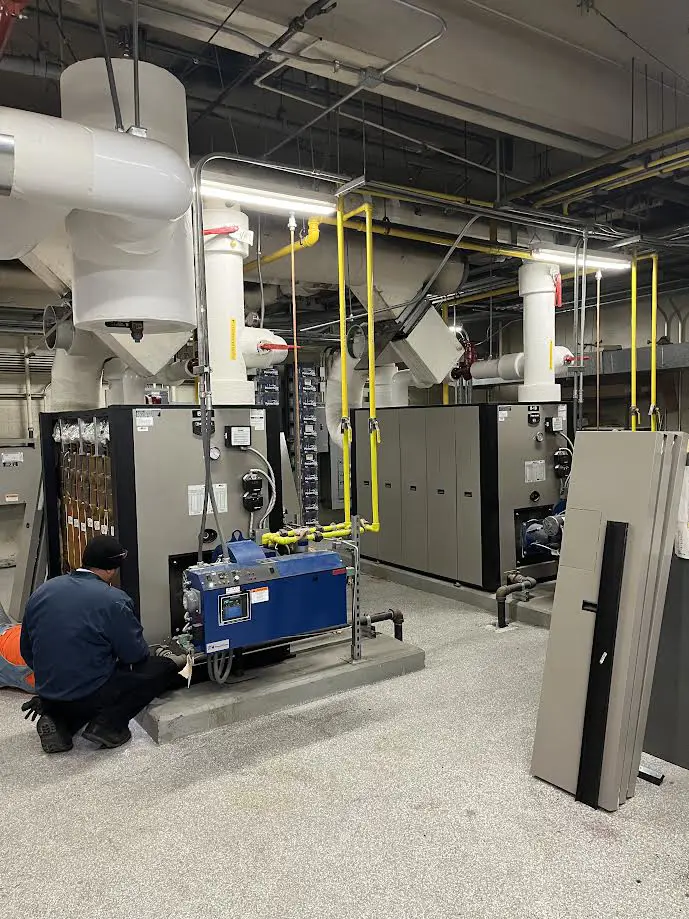
Each project moves through a structured process designed to improve reliability, avoid improper equipment sizing, and prepare the system for long-term operation.
We discuss operating conditions, equipment concerns, temperature problems, energy goals, production demands, and future facility plans.
Our technicians inspect existing systems, mechanical areas, airflow, controls, equipment access, and the conditions affecting cooling performance.
Facility size, equipment heat, occupancy, ventilation, production schedules, and environmental conditions are used to determine the required capacity.
We recommend cooling equipment and controls suited to the facility rather than oversizing or undersizing the system.
Equipment, refrigerant lines, electrical systems, airflow components, and controls are installed according to project and manufacturer requirements.
We test airflow, pressures, refrigerant levels, safety controls, operating temperatures, and system response before completion.
System controls are programmed and calibrated to maintain stable temperatures while supporting energy-efficient operation.
Ongoing inspections, cleaning, adjustments, and scheduled repairs help reduce downtime and extend equipment life.
Industrial cooling equipment does not simply create cold air. It continuously absorbs unwanted heat from equipment and occupied spaces, transports that heat through the system, and releases it elsewhere.
Warm air passes across the evaporator coil, where refrigerant absorbs heat from the facility.
The refrigerant changes state and carries absorbed heat through sealed piping toward the condenser.
The condenser releases heat outdoors or into another cooling medium before the cycle begins again.
Industrial cooling design must account for the building, equipment, production environment, and future operational needs.
Square footage, ceiling height, room arrangement, mechanical areas, and airflow paths influence cooling design.
Motors, electronics, production machinery, and processing equipment can generate substantial heat.
Continuous operation and peak production periods may require different capacity and control strategies.
Humidity control may be needed to protect products, limit corrosion, reduce mold risk, or support manufacturing.
Fresh-air requirements, exhaust systems, and indoor air quality must be coordinated with cooling performance.
Stable temperatures help support safer, more comfortable, and more productive working conditions.
Equipment and controls can be selected to improve performance while reducing unnecessary energy consumption.
Planning can account for future equipment, production growth, building additions, and changing cooling needs.
Industrial cooling equipment represents a substantial investment. Routine maintenance helps identify worn parts, airflow restrictions, control problems, and efficiency losses before they cause an unexpected shutdown.
Small system problems often become major failures when inspections are postponed. A planned maintenance program allows repairs to be scheduled around operations rather than handled during an emergency.
Service Mechanical Controls can evaluate your facility, calculate its cooling requirements, recommend appropriate equipment, and develop a service plan designed to support reliable operation.
Request Industrial Cooling ServiceLorem ipsum dolor sit amet, consectetur adipisicing elit. Molestiae iure voluptas facilis, debitis esse praesentium earum enim corporis vero! Delectus at nesciunt impedit soluta iste! Ullam eius pariatur ratione hic.
